Plugins
Extension packages build on package:flutter_unified_map/plugin_api.dart, in the spirit of flutter_map's own
plugin API. The first one is the marker cluster.
Marker clustering
flutter_unified_map_marker_cluster — GitHub —
animates clusters on the native maps with the API of flutter_map_marker_cluster: MarkerClusterLayerWidget,
MarkerClusterLayerOptions, animated split and merge, spiderfy. On web, Windows and Linux it runs the real
flutter_map_marker_cluster inside the map (through FlutterMapLayer), so the clustering looks the same everywhere.
Its demo is one cluster over Brussels: zoom in and the pins dispatch over the area, zoom out and they pack back into the one cluster —
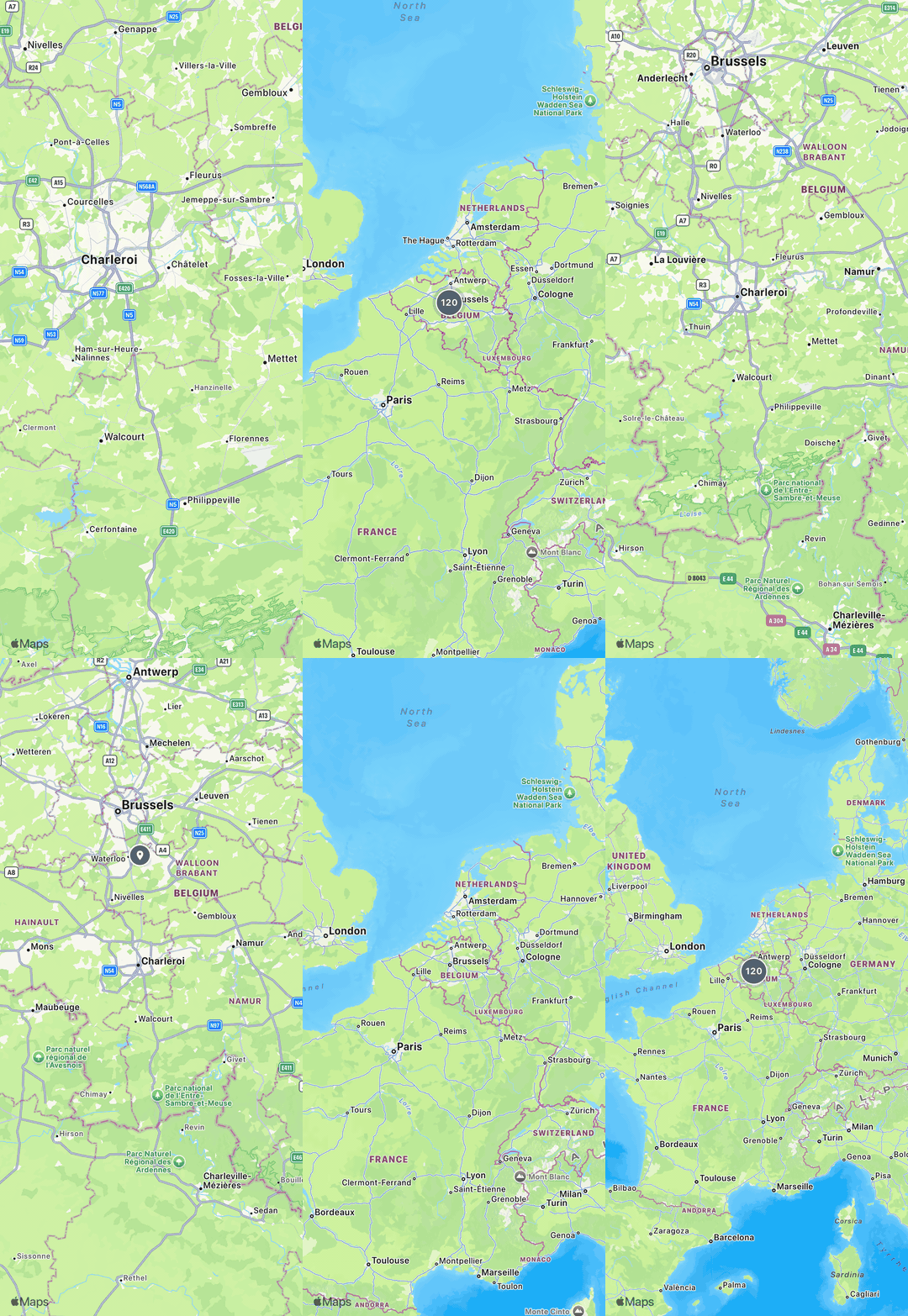
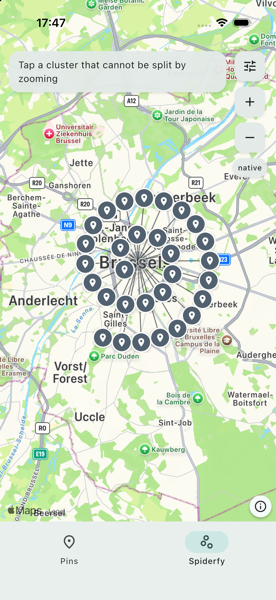
— and when zooming cannot split pins that share one point, a tap on their cluster spiderfies it: the pins glide out on a spiral, each with a leg back to the cluster, and a map tap folds them back in.
MarkerClusterLayerWidget(
options: MarkerClusterLayerOptions(
markers: markers,
maxClusterZoom: 10,
onClusterTap: (controller, cluster) => controller.animateTo(
dest: cluster.latLng,
zoom: cluster.zoom + 2,
),
),
)
Creating plugins
- a layer is a
MapLayerState: it receives an id, publishes markers throughMarkerPublisher(rasterised once per icon key), and pushes its shapes to the platform with each frame's diff; MapLayerHostexposes the camera (liveCamerawhile moving,idleCamerawhen settled),integerZoom, andsetFlutterMapLayersfor backends that can host flutter_map's own layer widgets;- markers animate through
MarkerTransition(appearFrom,disappearTo, glide) with the platform's easing.
The marker cluster package is the reference implementation — read its source alongside the API.
Sharing code with a flutter_map app
FlutterMapLayer(child: ...) puts a raw flutter_map layer inside UnifiedMap: drawn inside the map on web,
Windows and Linux; ignored on the native maps (Android, iOS, macOS). Use it to share code with an existing
flutter_map app while the native backends take over.